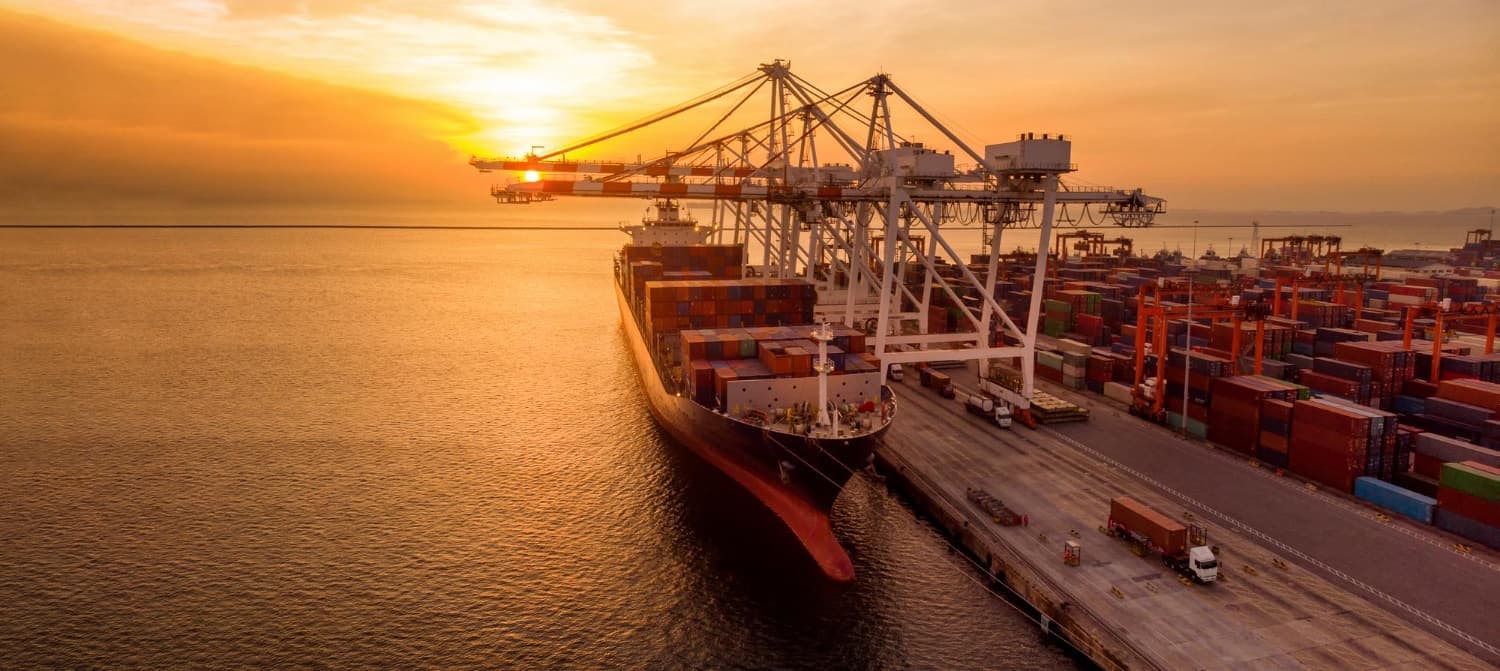
Look at a port from above and you will see thousands of steel boxes stacked like building blocks. Those boxes carry most of the manufactured goods that cross the oceans, from phones and clothing to machine parts and food. The system behind them is called container shipping.
This guide explains what container shipping is, the container types and sizes, how many containers a ship can carry, what it costs and how the process works.
What is container shipping?
Container shipping is the transport of goods in standardised steel containers, usually on ocean vessels, with road and rail connections at each end. Because every container has the same fittings, it moves between ship, truck, train and crane without the cargo inside being unpacked. That makes loading faster, cuts handling damage and lowers the cost per unit.
You can book a whole container for your cargo, called FCL, or share one with other shippers, called LCL. Our guide to FCL shipping covers the full container option in detail.
Container details and sizes
Two lengths dominate global trade: 20 foot and 40 foot. A 40 foot high cube container is one foot taller than the standard 40 foot box.
| Container | Approx. internal length | Approx. internal volume | Typical payload |
|---|---|---|---|
| 20 foot | 5.9 m | About 33 cubic metres | About 21 tonnes |
| 40 foot | 12.0 m | About 67 cubic metres | About 26 tonnes |
| 40 foot high cube | 12.0 m | About 76 cubic metres | Similar to a 40 foot box |
Internal width is about 2.35 m for all three. Exact figures differ slightly by manufacturer and shipping line, and payload also depends on road and rail limits at origin, so confirm with your forwarder before you load.
Every container has identifiers you will see on documents:
- Container number. An owner code of three letters, followed by the letter U, a six digit serial number and a check digit.
- Seal number. Printed on the bolt seal that closes the doors. It must match the bill of lading.
- Tare weight, payload and maximum gross weight. Printed on the door.
Types of containers
| Type | What it is | Typical use |
|---|---|---|
| Dry or general purpose | Closed steel box | Most manufactured goods and packed cargo |
| High cube | Taller dry container | Light, bulky cargo |
| Reefer | Refrigerated container with temperature control | Food, pharmaceuticals, flowers |
| Open top | Roof removed, covered with a tarpaulin | Tall cargo loaded from above |
| Flat rack | Platform with end walls or none | Heavy machinery and oversized items |
| Tank container | Steel tank inside a frame | Liquids, chemicals and gases |
| Ventilated | Openings for airflow | Produce and cargo that needs ventilation |
Special containers cost more to hire and may limit which vessels and ports can take them. Dangerous goods need approved packaging and declarations, and carriers can refuse them on some services.
Container vessel sizes
Container ships are described in TEU, or twenty-foot equivalent units. A 20 foot container counts as one TEU and a 40 foot container as two.
| Class | Approximate capacity |
|---|---|
| Feeder | 300 to 1,000 TEU |
| Panamax | About 5,000 TEU |
| Neo-Panamax | Up to about 14,000 TEU |
| Ultra-large container vessel | 18,000 TEU and above |
The largest ships can carry well over 20,000 TEU. Feeder ships connect smaller ports to large hubs, and the biggest vessels run between major hubs in Asia, Europe and North America.
How many containers can a ship carry?
TEU is a measure of space, not a count of boxes. A ship rated at 20,000 TEU could carry 20,000 twenty foot containers, or 10,000 forty foot containers, or a mix. In practice, the number of boxes is lower than the TEU figure because most containers are 40 foot. Real loads are also limited by weight, stability and the mix of empty and loaded boxes.
How container shipping works
- Booking. The shipper or forwarder books space on a vessel and receives a booking number.
- Empty container release. The line releases an empty container to a depot or the shipper's premises.
- Stuffing. Cargo is loaded and secured, and the container is sealed.
- Gate-in and export clearance. The container enters the port before the cut-off, and customs approves loading.
- Loading and sailing. Cranes lift the container onto the ship. Many routes include a transhipment at a hub port.
- Discharge and import clearance. The container is unloaded, customs assesses the cargo and duty is paid.
- Delivery and empty return. The container is trucked to the consignee, unloaded and returned to the line.
Our sea freight service covers each of these steps for both FCL and LCL cargo.
Container shipping costs
The price of a container movement is built from several layers:
- Ocean freight. A flat rate per container for the route and size.
- Surcharges. Fuel, currency, peak season and port congestion charges.
- Origin charges. Trucking, terminal handling, export documentation and customs.
- Destination charges. Terminal handling, delivery order and local transport.
- Container delay charges. Demurrage and detention if the box is held beyond the free days.
- Duty and taxes. Paid on imports.
- Insurance. Optional but advisable.
Rates move with the route, the season, fuel prices and the balance of empty containers. Compare complete quotes rather than headline freight rates, and use our guide on how to calculate international freight charges when you review them.
Benefits of container shipping
- Lower cost per unit. Standard boxes and large ships spread the cost across more cargo.
- Security. Cargo stays sealed from loading to delivery.
- Less handling damage. Goods are not unpacked at each transfer.
- Intermodal flexibility. The same box moves by ship, rail and truck.
- Scalability. You can ship a few cubic metres as LCL or fill a full container.
- Predictable schedules. Regular services run on fixed routes and sailing days.
- Tracking. Each container number can be followed through the journey.
Limitations
- Port congestion and weather can delay sailings.
- Transit is slower than air.
- Container availability and rates swing with demand.
- Very large or irregular cargo may need special equipment.
- Delay charges can add up quickly if clearance runs late.
Container shipping with IWCC
Interworld Cargo Care works with more than 50 shipping lines and handles booking, container planning, port coordination and customs clearance under one team. Whether you ship a few cubic metres or a full container, we compare options and quote the full route before you commit.
Plan your container shipment
Share your cargo volume, weight and route, and we will recommend the container type and quote the full cost. Get a free quote or call 098110 59654.