You send the same box by air twice and get two different bills. The reason is rarely the airline. It is usually the weight the airline charged for, the route and the surcharges added on top.
This guide explains how air freight charges are calculated in India, what sits inside an air freight quote, what drives international air freight rates per kg and how to keep the total under control.
How air freight prices are built
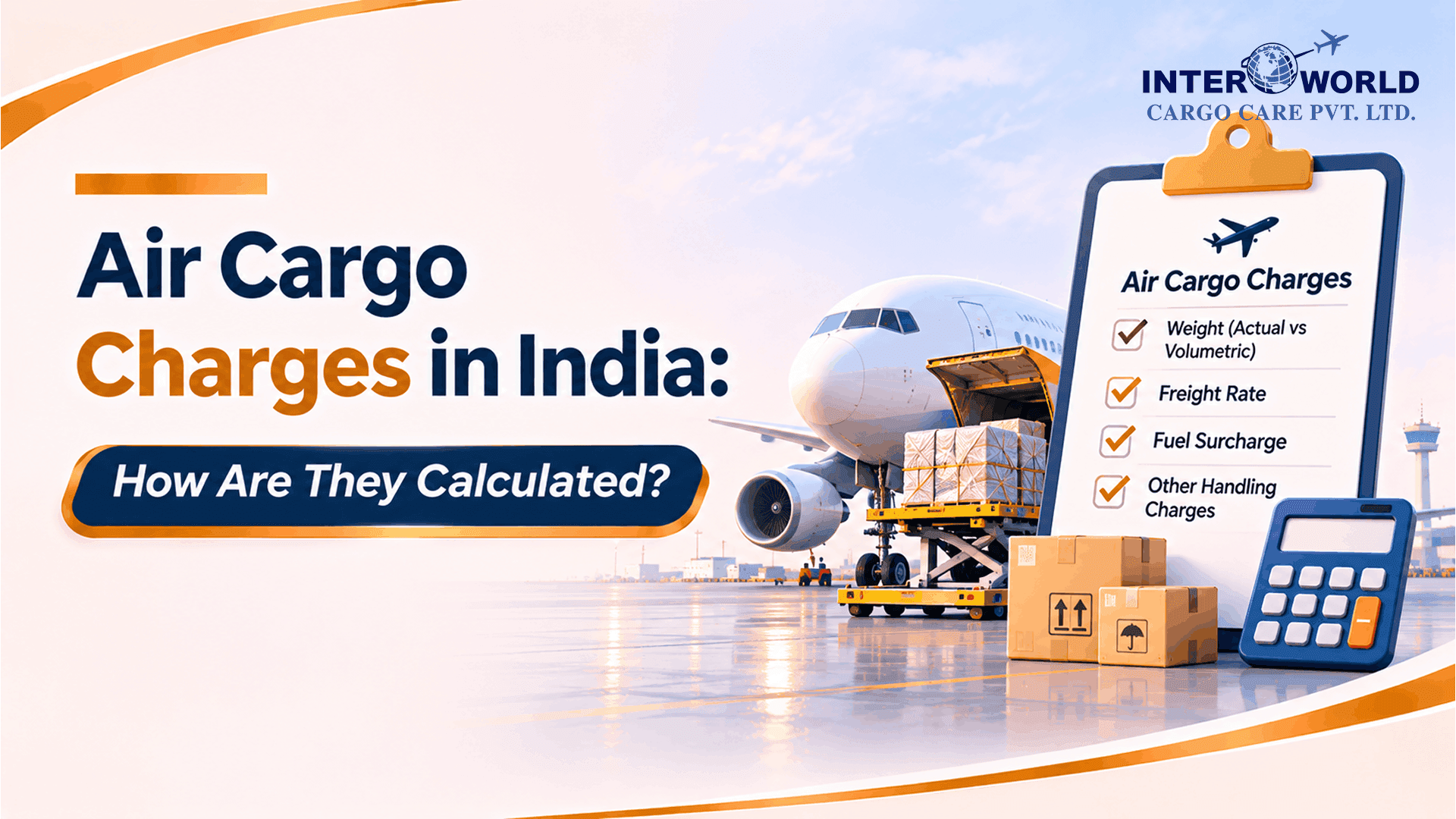
An air freight quote is a base rate multiplied by weight, plus a set of add-on charges. In most quotes you will see four layers:
- Base rate per kg. The airline or forwarder's rate for your route, applied to the chargeable weight.
- Surcharges. Fuel, security and sometimes seasonal or risk charges.
- Origin charges. Costs at the Indian airport and before it.
- Destination charges. Costs after landing, which are often billed separately.
Each layer can change independently, which is why two quotes for the same shipment can look very different until you compare them line by line.
Step 1: Work out the chargeable weight
Airlines have limited space and weight on each flight. A light but bulky carton uses as much space as a heavy one, so airlines charge on whichever is greater:
- Actual weight. What the cargo weighs on the scale, packaging included.
- Volumetric weight. Length x width x height in centimetres, divided by 6000. This divisor is the IATA standard and equals 167 kg per cubic metre.
The higher of the two is the chargeable weight. Cargo denser than 167 kg per cubic metre is charged on actual weight. Lighter cargo is charged on volumetric weight.
Example. A carton measures 120 x 80 x 100 cm and weighs 120 kg.
- Volumetric weight: 120 x 80 x 100 = 960,000, divided by 6000 = 160 kg
- Actual weight: 120 kg
- Chargeable weight: 160 kg
You pay for 160 kg, not 120 kg. Our guide on how to calculate international freight charges covers this rule for both air and sea.
Step 2: Apply the base rate per kg
The base rate depends on the route, the airline, the type of aircraft and how full the flight is. It usually falls as the weight rises, because airlines offer lower rates per kg at higher weight breaks. A shipment of 500 kg often has a lower rate per kg than one of 50 kg.
International air freight rates per kg also vary by:
- Lane. Busy routes with many flights tend to cost less than thin routes with few departures.
- Capacity. Cargo carried in the belly of passenger planes depends on the passenger schedule. Dedicated freighters are priced differently.
- Service level. Airport to airport costs less than door to door.
- Season. Rates rise when demand peaks, such as before major shopping and holiday periods.
- Fuel prices. Airlines adjust rates, or the fuel surcharge, as jet fuel moves.
Because rates change often, ask your forwarder for a current quote with a validity date instead of relying on figures from an old price list.
Step 3: Add surcharges
Common surcharges on an air freight quote include:
- Fuel surcharge. Linked to jet fuel prices and usually charged per kg.
- Security surcharge. Covers cargo screening.
- Peak season surcharge. Applied when demand is high.
- Dangerous goods surcharge. Extra handling and paperwork for restricted items such as batteries or chemicals. The premium depends on the class of the goods.
- War risk or other risk surcharges. Added on some routes.
Not every surcharge applies to every shipment. Ask which ones are included in the quoted rate and which are billed on top.
Origin charges in India
Before the cargo reaches the aircraft, you may pay for:
- Pickup from your premises and transport to the airport cargo terminal.
- Terminal handling. Charged by the airport cargo terminal for receiving and storing the cargo.
- Airway bill (AWB) fee. The cost of issuing the air waybill.
- Screening and security checks.
- Export documentation and customs clearance. For export filing, see our guide on the shipping bill and how it is filed.
- Packing, labelling and palletising, if the forwarder does it.
Destination charges
These are paid at the arrival airport and often sit outside the base quote:
- Terminal and handling charges at the destination airport
- Import customs clearance
- Duties and taxes, which depend on the goods and the destination country
- Delivery to the consignee
Under some trade terms the seller pays destination costs, and under others the buyer does. Check the Incoterm in your contract so you know who pays what.
A simple cost build-up
For illustration only, assume a base rate of ₹300 per kg and a chargeable weight of 160 kg:
| Item | Basis | Amount |
|---|---|---|
| Base freight | 160 kg x ₹300 | ₹48,000 |
| Fuel surcharge | Assumed 20% of base | ₹9,600 |
| Security surcharge | Assumed ₹10 per kg | ₹1,600 |
| Origin charges | Assumed lump sum | ₹5,000 |
| Total before destination | ₹64,200 |
These numbers are only a working example, not a quote. Real rates differ by route, airline and date. The table shows how the final bill builds up and why each line deserves a question.
What affects the final bill
- Packaging. Oversized boxes raise the volumetric weight. Tighter packing can cut the chargeable weight.
- Cargo type. Perishables, dangerous goods and high-value items cost more to handle.
- Urgency. Express services and direct flights cost more than routed or consolidated ones.
- Consolidation. Forwarders who combine small shipments can often offer lower rates per kg.
- Booking time. Last-minute bookings on busy lanes usually cost more.
- Contract rates. Regular shippers can sometimes negotiate fixed rates for a period.
How to lower your air cargo cost
- Right-size the packaging. Remove empty space and use compact cartons.
- Measure accurately. Wrong dimensions lead to bill corrections later.
- Book early. Lead time gives more choice of flights and rates.
- Compare itemised quotes. Ask for base rate, surcharges, origin and destination charges separately.
- Consider consolidation. Sharing space on a consolidated shipment can help for small loads.
- Check if air is needed. If your delivery date allows, sea freight may cost much less per kg.
How IWCC helps with air freight
Interworld Cargo Care is IATA accredited and has moved cargo since 1993. Our air freight service provides itemised quotes that separate freight, surcharges and local charges, so you can see what you are paying for.
Get an air freight quote
Share your cargo size, weight and destination, and we will send an itemised quote. Get a free quote or call 098110 59654.