A buyer abroad asks for a certificate of origin. Your customs broker asks for the same. Your shipment cannot clear without it, or the buyer pays more duty than expected. Many first-time exporters do not know what the document is or where to get it.
This guide explains what a certificate of origin is, the COO full form in export, the two main types, who issues it in India, the benefits and how to apply.
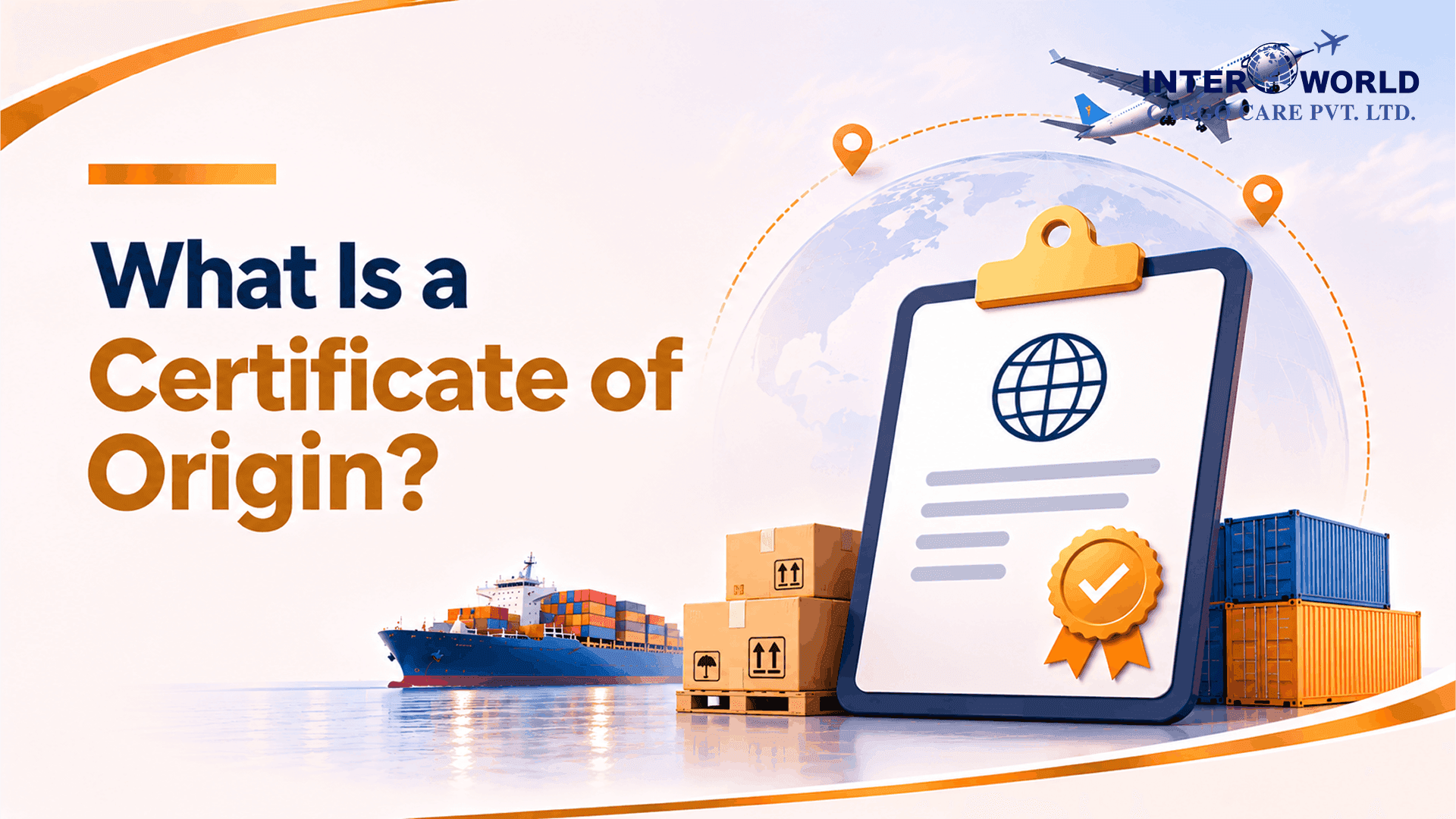
What is a certificate of origin?
A certificate of origin (CoO) is an official document that states the country where goods were produced or manufactured. It is issued by an authorised body, not by the seller, and it travels with the shipment. Customs in the importing country uses it to decide how the goods are treated.
In short, the invoice says what you sold and for how much. The certificate of origin says where the goods come from.
COO full form in export
COO stands for certificate of origin. You may also see it written as CoO or CO.
For export and import: why it matters
For exporters, the certificate proves that your goods are Indian-made. For importers, it lets customs apply the correct duty rate. It is used for:
- Duty assessment. The origin decides which tariff applies, including any reduced rate under a trade agreement.
- Trade rules. Some countries restrict or add duties on goods from specific origins, such as anti-dumping measures.
- Letters of credit. Banks often list the certificate as a required document.
- Trade statistics and compliance. Governments track imports by origin.
Types of certificates of origin
Non-preferential certificate of origin
This confirms the origin of goods only. It does not give a tariff concession. The goods pay the normal duty rate in the importing country. Buyers often ask for it for customs and bank requirements, even when no special tariff applies.
Preferential certificate of origin
This supports a lower or zero duty rate under a trade agreement between India and the importing country. It is issued only if the goods meet the agreement's rules of origin. Examples include certificates under the India-UAE CEPA and other trade agreements. The form name and the rules differ by agreement.
| Point | Non-preferential | Preferential |
|---|---|---|
| Purpose | Proves origin | Proves origin and qualifies for reduced duty |
| Tariff benefit | None | Yes, under the agreement |
| Rules of origin test | Basic origin check | Must meet the agreement's specific rules |
| Typical use | Customs and bank requirements | Exports to countries with a trade agreement |
Who issues a certificate of origin in India?
India has nominated several bodies to issue certificates, including:
- Chambers of commerce, for many non-preferential certificates
- Export promotion councils and trade bodies
- Export Inspection Councils
- Other government agencies and commodity boards, depending on the product
- The DGFT, which runs the online platform
Which body you use depends on your product, the type of certificate and the agreement. Your customs broker can tell you which agency applies.
Benefits of a certificate of origin
- Lower duty for the buyer. A preferential certificate can reduce or remove import duty, making your price more competitive.
- Smoother customs clearance. Customs accepts the document as proof of origin.
- Meets buyer and bank requirements. Many letters of credit require it.
- Access to trade agreements. You can use the benefits India has negotiated with other countries.
- Fewer disputes. Origin queries at the destination are easier to settle with an official certificate.
Documents required
Requirements differ by agency, but you should expect to provide:
- Commercial invoice. Our guide to the commercial invoice shows what it must contain.
- Packing list
- Shipping bill or bill of lading, or airway bill
- Purchase order or contract
- Importer Exporter Code (IEC)
- Manufacturer and supplier details, if you are a trader and not the maker. Some applications need supplier invoices or a manufacturer declaration to prove where the goods were made.
- Product details with the HS code. See our guide to the HS code.
For preferential certificates, expect to show how the goods meet the rules of origin, such as the materials used or the share of value added in India.
How to apply for a certificate of origin online
India's DGFT runs a common digital platform for certificates of origin at coo.dgft.gov.in. It was first used for preferential certificates and later extended to non-preferential ones. Some issuing agencies may still accept paper applications, so ask the agency which route it prefers. A typical online process is:
- Register. You need your IEC, a valid email and mobile number linked to it, and a digital signature certificate. Aadhaar-based e-signing may be accepted in some cases.
- Log in as an exporter. Use the credentials given at registration.
- Start a new application. Choose the type of certificate and, for a preferential one, the trade agreement.
- Select the issuing agency and office.
- Enter shipment details. Add exporter and importer names, addresses, goods description, HS code, quantity and value.
- Upload documents. Attach the invoice, packing list and other papers.
- Declare and sign. Confirm the information and sign digitally.
- Pay the fee. Fees vary by agency and type of certificate.
- Track and download. Once approved, download the certificate. Digital certificates carry a QR code or number that can be used to verify them.
Processing times depend on the agency and how complete your documents are. Apply early, ideally before the goods are ready to ship, because some buyers need the certificate to release payment.
Check the details before you ship
Validity depends on the issuing authority and the agreement. If a detail is wrong, ask the agency to correct it before shipping, because a certificate that does not match the invoice can be rejected at the destination.
Common mistakes to avoid
- Applying after shipment. Many agencies expect the application before or soon after the goods leave.
- Mismatched details. The goods description, quantity and invoice number must agree across documents.
- Wrong HS code. This can affect which rules of origin apply.
- Choosing the wrong type. Applying for a non-preferential certificate when the buyer needs a preferential one means the buyer loses the duty benefit.
- Poor supplier records. If you trade goods you did not make, keep supplier documents ready.
How IWCC helps
Interworld Cargo Care helps exporters prepare the documents a certificate application needs and checks them against the shipment. Our customs clearance team coordinates with the issuing agency and the buyer's requirements, so your goods do not stall for a missing certificate.
Need a certificate of origin for your shipment?
Tell us what you export and where, and we will confirm what you need. Get a free quote or call 098110 59654.